Saturday, February 1, 2014

Salsa dancing is awesome.


I don’t know how, and I don’t know why, but somehow I have become completely obsessed with Latin dancing. For the last month, I’ve been attending a twice-weekly salsa class, and I think I’m finally starting to get the hang of it.


Social dancing is something that’s becoming increasingly a thing of the past. It’s either considered anachronistic or misconstrued entirely. Most people seem to automatically translate the phrase “going dancing” to “going clubbing.” Mind you, I have nothing against people who spend Friday nights at a club. It’s their way of letting off steam, but I’m not the kind of person who finds grinding up against total strangers enjoyable. I also have a problem with $35 door fees, an intense dislike of expensive watered-down drinks, a profound hatred for rooms full of people who are drunk or drugged out beyond comprehension, and a general disinterest in clubbing fashion. To each their own, I suppose. [Aziz Ansari has a wonderful bit that sums up my view up clubbing. Check it.]


Latin dancing, particularly salsa, is a whole different ball game. It’s got a rich cultural history, and it takes a lot of practice to master. Contemporary salsa dancing began in the 1970s in New York, drawing on cha-cha-cha and mambo influences, but the tradition goes way farther back. There’s actually an argument about whether or not mambo and salsa are the same dance, and there’s also a raging debate about who actually owns the dance. Some people trace it to the turn of the century, when American soldiers did stints in Cuba during the war and got a taste for Latin rhythms. The Spanish claim it through a tenuous linguistic link, the Dominicans feel very strongly about it, and others view it as a cornerstone of Latin American identity. It’s a very flirtatious dance, and several of the moves are easily translatable to other dance genres, like the merengue and the bachata.


(While we’re on the subject, tell me bachata isn’t the most beautiful and intimate dance you’ve ever seen!)


Fact: salsa isn’t easy. It may not take a lot of effort to learn the basic steps, but mastering them, uniquely styling them, and performing them with another person is a whole ‘nuther story. I will never forget my first time dancing it. Despite his past failures at dancing, one of my friends was kind enough to humor me and accompany me to a class in West Oakland at a local salsa studio. I picked up the footwork pretty easily, but adding another person into the mix made things ridiculously complicated. (It didn’t help that he was hopelessly clumsy, but he had a great attitude about it all, which is all that really mattered.) I didn't step on any toes, but I definitely did not like what I saw in the mirror.


A salsa dancing couple has two components: a leader and a follower. Purely through pressure on the shoulders and hands, the leader communicates to the follower what steps to take. Gaining the confidence to lead another person through a set of super involved and intricate moves is quite a feat, and it takes a special skill to for the follower to be able to successfully anticipate where on earth (well, the dancefloor) the dance is going. Put all of the complex moves over a song that’s anywhere from 160 to 220bpm, and you have a recipe for disaster. Mis-stepping, getting off the beat, kicking your partner in the knees, and accidentally elbowing somebody are all common plights of the beginner.


Personally, I’ve found the challenge to be quite engaging and very rewarding. Among other things, it’s a great way to get to meet new people. As somebody who recently graduated from college and had most of her friends move far, far away, this is a draw. By nature, salsa dancers are a very friendly breed -- a characteristic that may have something to do with the difficulty of the dance. Partners are frequently rotated, and nobody frowns down upon you for being a beginning dancer. It’s also a great character study. You can tell a lot about a person from their dancing frame -- ie, are they confident? Do they hold themselves upright? Do they trust themselves enough to lead, and do they trust you to know how to follow? Sometimes, you’re partnered with somebody who’s there with the sole intention of having a good time, and it feels great. Other times, you’re partnered with a diva who feels the need to show off and ends up slouching and sulking when they make a mistake (something that’s bound to happen). Depending on the character of your partner, you either never want the song to end, or you can’t wait for the dance to be over.


It’s a disciplined kind of enjoyment. You have to invest time into learning the steps, you need to stay with the rhythms, and you have to feel confident about yourself and your skills to be able to dance with a partner. A drink or two may help you loosen up a bit, but you cannot go out to a club, get mindlessly drunk, and expect to rock the dancefloor. It's one of those endeavors that gives you back exactly what you put into it. But who wouldn’t feel good being able to dance like this?


I’m not saying it’s for everybody, but I definitely enjoy it. Come dancing with me?

The Marriage of Sticks

With the end of 2013 came the end of my career as an undergraduate student. Due to my being Slavic Cultures major, my last few semesters of school were entirely consumed with reading up on Russian Imperial history and the Soviet era. With this came reading through reams and reams of 19th and 20th century literature -- something I enjoyed immensely (to be honest, it was the sole reason I opted to declare a second major in the absurd and highly impractical field of Slavistics). Over the course of my studies, I discovered a bunch of authors whom I came to adore, such as Ivan Goncharov, Andrei Platonov, Venedikt Yerofeev, Andrei Bely, Aleksandr Blok, Vladimir Mayakovsky


I could go on and list for ages.


As many bookworms know, Russian literature (well, Slavic literature in general) isn’t typically the most cheery genre in existence. It tends to be full of suicide, existential angst, and disillusionment with the world at large. I have fond recollections of the conversations I overheard in the hallways of the Smolny campus of St. Petersburg State University during my brief stint as a student in Russia. They all went a bit like this:


Student: So, how does the story end?
Professor: He dies.
Student: What? Him too?
Professor: Yes. Eet ees a very Russian ending.

Novel upon novel of doomed characters and unhappy endings naturally take a toll on one’s optimism and cheeriness. So as not to become the most glum person in existence, I made a pact with myself to refrain from reading Russian books for a while after I graduated.


Well, …


I made a conscious effort.


Russian literature is following me around, man. In an attempt to break out of the existential black hole of Slavic cynicism, I picked up Jonathan Carroll’s The Marriage of Sticks. I had encountered Jonathan Carroll before -- years ago, when I took a Gothic Literature class during my formative years in community college. I knew him from his The Land of Laughs, an adorable yet terrifying book about children’s stories coming alive. I sort of knew what to expect from him; he writes literary themed stories that are tinged with the occult and classic gothic-style nightmarish terror.

Exhibit A: Author Jonathan Carroll. Obviously a very cheery person. What was I thinking?!


All things considered, The Marriage of Sticks is an absolutely phenomenal book and a must-read for any former English/Comparative Literature major or used bookseller. It’s a story about a highly successful used bookdealer who never manages to have a successful romantic relationship, and it’s full of paragraphs like the following:


Just this morning, right before you arrived, I was thinking about a picnic I had with the Hemingways at Auteuil. Lewis Gallantiere, Hemingway and mad Harry Crosby [sic. I can’t emphasize my love for the Oxford comma enough.] Why those two men ever got along was beyond me, but it was a lovely day. We ate Westphalian ham and Harry lost three thousand francs on the horses.


At college I had read a poem by Whitman about an old man in a boat, fishing. He has lived a full life, but is tired and now peacefully waiting to die. Until then, he’s content to sit and fish and remember. Even as a kid, full of pepper and brass, I was enchanted with the idea of living so fully that at the end you had nothing left you wanted to do and were willing to die. Years later, Frances Hatch became a living example of that and her influence on me was profound.


It’s like intellectual porn, masturbating the readerly ego as one recognizes all of Jonathan Carroll’s artsy fartsy references. (He’s brilliant. More about him here.) Did you recognize the Whitman poem?


It’s also got a bunch of witty paragraphs geared towards self-reflection, ie:


In the end, each of us has only one story to tell. Yet despite having lived that story, most people have neither the courage nor any idea of how to tell it.


It’s too easy to turn your best profile to history’s mirror. but history doesn’t care. I have learned that. Mirrors and treasure maps. X marks the spot not where a life begins, but where it begins to matter. Forget who your parents were, what you learned, what you did, gained or lost. Where did the trip begin? When did you know you were walking through the departure gate?


The main character is middle-aged Miranda Romanac. She’s afraid to become emotionally vulnerable to people, so she has a slew of one night stands and generally unsatisfying intimate relationships. In order to try to get herself through the dreariness of everyday existence, she holds on tightly to the memory of her high school romances. The book is full of colorful characters, such as quirky modern art dealers, crazy artists, Hungarian psychic gypsies, and ghosts of lovers past. Here’s where the Russian literature comes in: there’s a crazy book editor that runs around the streets of New York breaking the hearts of men with a line of Mayakovsky tattooed on her wrist -- “Hope gleams in the idiot heart.”


If you’re looking for a cheerful read, I wouldn’t really recommend this title. It’s far too Russian in nature. I never give spoilers, but it doesn’t end well. If, however, you’re looking for something that will engage you and make you think, pick it up. It doesn't disappoint.

Thursday, August 15, 2013

In Defense of Writing Letters


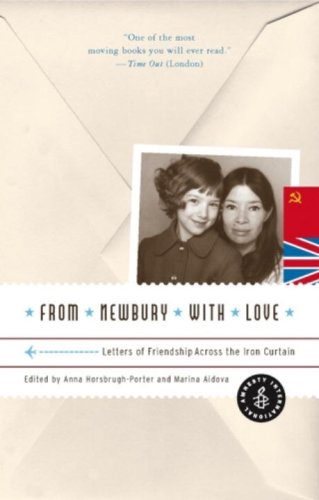
My life is a joke and rife with coincidence. I was walking to the mailbox earlier (yes, at 1:30AM) to drop off a letter, and I found this book on top of the mailbox, along with a post-it note that said “free” on it: 


Some kind and thoughtful soul evidently wanted to share the book with anyone who was interested. It’s a compilation of written correspondence bridging the Iron Curtain. This amuses me on two levels: 1) I’m obsessed with Soviet history, 2) I’m currently on a crusade to revive the lost art of Writing Letters. I can’t wait to read it.

Let’s breeze past my obsession with the Cold War era.

Letters seem to be a dying art, and I completely understand why. We live in a digital age -- people are captivated by technology and speed. We can’t be arsed to read the paper, so we get our news from tweets. Faxing takes too long; we prefer to send scans. Paging was cool in the 90s, and then we decided that it took too long to wait for somebody to call us back and started using cell phones. Phone calls take too much of our time: we prefer to circumvent the obligatory “Hello, how are you?” or the possibility that we might get forwarded to a voicemail box and simply text our friends and acquaintances when we need something from them. Instead of taking the time out of our day to call and chat with friends, we prefer to stalk them on Facebook and occasionally become passively involved in their lives by “liking" their status updates if we can find time away from broadcasting our own narcissism into the virtual ether (no, I'm not bashing Facebook. It's practical and convenient and I use it a lot). Sadly, In such an age, letter-writing (completely understandably) falls to the way side.

Now, here’s why I think people should still write letters:
  • It takes time. It forces you to slow down and smell the proverbial roses. You have to sit down and collect your thoughts. You have to disconnect yourself from the fast-paced digital world for a moment and remember that there is a life outside of the internet (I know. It’s an earth-shattering concept). Because it takes so much time, it shows that you truly do think and care about the recipient. If you want to write a good and thoughtful letter, you simply cannot do it in two minutes. You’re probably going to be sitting there for at least twenty if you want to produce a piece of writing that somebody else is going to want to read. 
  • It’s a mental exercise. Sure, you can still write a thoughtful letter to somebody via email. There’s a crucial difference between writing something on the computer and writing something on a piece of paper, however, and that is the backspace key. You can fix an error on the computer very easily: a few key strokes, and voila! Not so when you’re writing a paper letter -- it turns into a very unpleasant and messy process involving gloopy, gunky, sticky, yucky correctional fluid. This places emphasis on getting things right the first time -- something that we don’t seem to worry about much nowadays. (Just think of digital photography: once upon a time, taking crappy pictures cost a lot of money -- you had to buy film and pay to have them developed. Nowadays, you easily end up with megabytes upon megabytes of shitty photos you’ve forgotten to delete off your harddrive). Granted, it’s great to be able to fix your mistakes on the computer, but the relative easiness of doing so causes many people to become complacent and slack off in terms of accuracy. Additionally, there’s something satisfying about the act of holding a pen to paper, and you’re more likely to remember what you’ve written if you’ve taken the time to actually physically write it down.
  • It’s aesthetically pleasing. On many levels. There are multiple considerations that go into creating a letter: 1) you have to select a paper, 2) you have to select a pen, 3) you show off your penmanship, and 4) you have to choose a stamp. Paper alone is a difficult choice -- there’s different textures, colors, and watermarks from which to choose.  You can even opt to have it scented. Pens pose another serious dilemma -- will you opt for the elegance of a fountain pen, or are you going to go with the more practical and simple ballpoint pen? What color ink will you choose? The way you form your characters (is it cursive or print? are you writing hurriedly?) reveals a lot about your state of mind. If you’re feeling super classy, you can give the envelope a wax seal and gild it. Finally, you have to choose a stamp. There’s many variables that show off various aspects of your personality and the degree of involvement that went into creating the final document. With an email, you’re limited to choosing a font, how you’re going to format your paragraph breaks, and deciding whether or not you’re going to insert images.
  • There's no immediate gratification. It takes time for the letter to reach the recipient, and it takes additional time for the recipient to draft a response. Depending on where you're sending the letter, this can be a few days or a few weeks. You don't get an immediate confirmation or receipt, or an immediate gleeful outburst of "THANK YOU! YOU'RE AN AWESOME PERSON FOR DOING THIS!" You simply have to hope and trust your efforts will be gratified with a response. This teaches you two things: 1) patience, 2) suspension of expectation. Emails and text messages kill our realization that people have lives outside of our own. Just think of how many times you've been angry at a person for not immediately replying to your text message, or how many times you've neurotically refreshed your email inbox when you were expecting an urgent email. Mail is only delivered once daily -- checking your mailbox neurotically is futile and inherently idiotic (something you realize perhaps only when you catch yourself doing it).


Yes, the act of writing a paper letter is an involving and time-consuming process. Yes, it’s a bit old-fashioned and definitely not a practical way of communicating urgent information. There's a thousand and one additional arguments you can make against the act. Nonetheless, I think it still has a place in contemporary society. Next time you’re feeling bored, get your ass off Facebook and try walking into a paper store. They are actual places that exist, and they are not merely havens for hipsters and stuck-up people who should live in another century. See what you end up walking out of there with. You’ll realize that the post office has other uses besides distributing bills and junk mail. I can guarantee you there’s really no better feeling when you open your mailbox and see a letter from a friend.

Friday, August 9, 2013

I Hate Television.

For years, I was adamant about the fact that television sucked. I sold my TV, canceled my cable service, and went on an angry crusade about how television was completely ruining society. I saw it as a devilish box created to glue people to their sofas as they munched on potato chips and turned into stereotypical fat Americans. I refused to speak about any shows, laughed at people when they gave me recommendations, and generally acted like a grandiose jerk to anybody who didn’t agree with me.

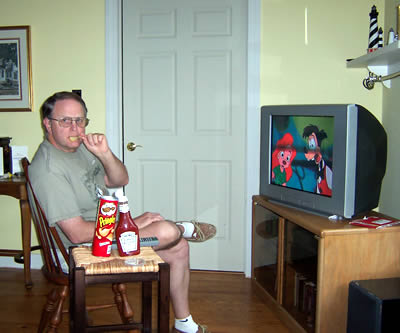
Exhibit A: Mindless TV viewer munching on potato chips.
I’m still pretty steadfast with my opinion, but there has been a few things lately that have poked a few holes in it. Notably, two shows: Netflix’s House of Cards and HBO’s Newsroom.

WHY?

Let me explain. I like things that make consumers think. I read books obsessively because they make me think. The process is intensely self-gratifying -- by reading and engaging myself in a complex narrative, I can tell myself that I am intellectual and thereby feel smart. It’s an ego thing. By watching these two shows, I am able to do make a similar claim to myself. 

House of Cards (first airing in February or this year) may or may not count as a television show. It airs on Netflix exclusively, which exempts it from any sort of regulation. This is awesome, as it allows the producers to do whatever they want (well, whatever Netflix wants them to do). The show is produced by Beau Willimon and it’s an adaptation of a previous BBC series by the same name. It dramaticizes American politics in all of their gritty glory (shame?). Through intensely suspenseful personal narratives, it sheds light on sides of American politics that may not be readily recognized by the average viewer. It breaks down the system of congress and makes people understand why Congressmen act the way they do. It sheds light on personal agendas and corporate interests that come do play in the process of drafting American law. Granted, because it’s television, it may be a bit overly dramatic, and the narratives may be extreme (suicide, murder, drug use, spousal issues). Nonetheless, it educates and raises awareness. And it stars Kevin Spacey.

Newsroom is an HBO series produced by Aaron Sorkin of The Social Network fame. It began airing in 2012. The show, aside from chronicling the drama caused by the overblown ego of prominent news anchor Will MacAvoy, deals with the way that our news is manufactured and produced. It alerts the viewer to how news can be biased or choose to omit certain stories. It also throws in tons of actual events and has its basis in journalistic reality. The end goal seems to be to educate viewers on current events (well, semi-current -- the setting is 2011-2012) they may have missed, and to alert them to be more attentive to the way they consume news.

To me, these two shows epitomize what television should be. They’re smart, they’re socially relevant, they educate, and they entertain. The writing is tight, witty, and intelligent. It’s not an easy to create shows like that, especially in a country that seems to run on reality TV garbage (16 & Pregnant anybody? Blargh.).  I respect their producers and writers, and I cannot wait to see where both of them go.

I still hate TV with a passion that I cannot quite put into words. I may scream if somebody mentions Jersey Shore to me one more time. But, for now, I’m going to rescind my absolute condemnation of television and say, “There may be some good things out there.”

Tuesday, August 6, 2013

This bears reading.


For the past few weeks, I've been reading a book by Andrei Platonov entitled Happy Moscow. I started it when I was still overseas in St. Petersburg. My edition of the book has been through a lot -- it went on a train ride to Moscow, it visited Valaam, it was touched (read: severely water-damaged) by St. Petersburg's summer showers, and then it took a detour to Mexico City when United Airlines lost my luggage as I was traveling back home to Oakland. I finally finished the book today and realized that the NYBR edition of it does not contain merely the story bearing the name "Happy Moscow," but it also contains the three short stories out of which the novella was constructed, a screenplay that was never filmed entitled "Father," and an essay entitled "On the First Socialist Tragedy." 

The essay is what got me.

It's been a while since I've encountered a single piece of writing that has made such a strong impact on me, and I read a lot. I read a lot of socialist realist books and banned literature from the USSR. Everything published in that part of the world in that era deals in some way with the idea of a communist utopia, alternately condemning and praising it. I frequently flirt with the ideas of socialism and communism and study the history surrounding them extensively. Ultimately, I'm torn on where I stand with it all -- so I'm not even going to go into that. This piece of writing deals with so much more than that, though. Platonov was, for all his ideological flaws, a believer in the promise of the communist utopia. It's evident when you read the piece. He wrestled extensively with the industrialization of the Soviet Union, however, believing that mechanizing and calculating everything with ultimately destroy humanity.

Although it was written in 1934 and talks a lot about circumstances that were unique to the Soviet Union, I'm going to argue that it remains relevant today. It's Platonov talking about what it means to be human in the context of rapid industrialization and amazing technological discoveries. He reminds us that the fact that we CAN do something doesn't necessarily mean that we SHOULD do it. Technology is evolving at a pace much faster than the human mind. On one hand, that's great. I'm all for science and the pursuit of knowledge. The danger lies in the abuse of the knowledge found. Hopefully ethics will catch up to our inventions, and SOON. 

There are two editions of the essay. The shorter one is reprinted below. If you like what you read, I strongly urge you to go dig up the longer one. It bears reading. 

ON THE FIRST SOCIALIST TRAGEDY

One should keep one’s head down and not revel in life: our time is better and more serious than blissful enjoyment. Anyone who revels in it will certainly be caught and perish, like a mouse that has crawled into a mousetrap to ‘revel in’ a piece of lard on the bait pedal. Around us there is a lot of lard, but every piece is bait. One should stand with the ordinary people in their patient socialist work, and that’s all.
This mood and consciousness correspond to the way nature is constructed. Nature is not great, it is not abundant. Or it is so harshly arranged that it has never bestowed its abundance and greatness on anyone. This is a good thing, otherwise—in historical time—all of nature would have been plundered, wasted, eaten up, people would have revelled in it down to its very bones; there would always have been appetite enough. If the physical world had not had its one law—in fact, the basic law: that of the dialectic—people would have been able to destroy the world completely in a few short centuries. More: even without people, nature would have destroyed itself into pieces of its own accord. The dialectic is probably an expression of miserliness, of the daunting harshness of nature’s construction, and it is only thanks to this that the historical development of humankind became possible. Otherwise everything on earth would long since have ended, as when a child plays with sweets that have melted in his hands before he has even had time to eat them.
Where does the truth of our contemporary historical picture lie? Of course, it is a tragic picture, because the real historical work is being done not on the whole earth, but in a small part of it, with enormous overloading.
The truth, in my view, lies in the fact that ‘technology . . . decides everything’. Technology is, indeed, the subject of the contemporary historical tragedy, if by technology we understand not only the complex of man-made instruments of production, but also the organization of society, solidly founded on the technology of production, and even ideology. Ideology, incidentally, is located not in the superstructure, not ‘on high’, but within, in the middle of society’s sense of itself. To be precise, one needs to include in technology the technician himself—the person—so that one does not obtain an iron-hard understanding of the question.
The situation between technology and nature is a tragic one. The aim of technology is: ‘give me a place to stand and I will move the world’. But the construction of nature is such that it does not like to be beaten: one can move the world by taking up the lever with the required moment, but one must lose so much along the way and while the long lever is turning that, in practice, the victory is useless. This is an elementary episode of dialectics. Let us take a contemporary fact: the splitting of the atom. The same thing. The worldwide moment will arrive when, having expended a quantity of energy n on the destruction of the atom, we will obtain n + 1 as a result, and will be so happy with this wretched addition, because this absolute gain was obtained as a result of a seemingly artificial alteration of the very principle of nature; that is, the dialectic. Nature keeps itself to itself, it can only function by exchanging like for like, or even with something added in its favour; but technology strains to have it the other way around. The external world is protected from us by the dialectic. Therefore, though it seems like a paradox: the dialectic of nature is the greatest resistance to technology and the enemy of humankind. Technology is intended for and works towards the overturning or softening of the dialectic. So far it has only modestly succeeded, and so the world still cannot be kind to us.
At the same time, the dialectic alone is our sole instructor and resource against an early, senseless demise in childish enjoyment. Just as it was the force that created all technology.
In sociology, in love, in the depths of man the dialectic functions just as invariably. A man who had a ten-year-old son left him with the boy’s mother, and married a beauty. The child began to miss his father, and patiently, clumsily hanged himself. A gram of enjoyment at one end was counterbalanced by a tonne of grave soil at the other. The father removed the rope from the child’s neck and soon followed in his wake, into the grave. He wanted to revel in the innocent beauty, he wanted to bear his love not as a duty shared with one woman, but as a pleasure. Do not revel—or die.
Some naive people might object: the present crisis of production refutes such a point of view. Nothing refutes it. Imagine the highly complex armature of society in contemporary imperialism and fascism, giving off starvation and destruction for mankind in those parts, and it becomes clear at what cost the increase in productive forces was attained. Self-destruction in fascism and war between states are both losses of high-level production and vengeance for it. The tragic knot is cut without being resolved. The result is not even a tragedy in a classical sense. A world without the ussr would undoubtedly destroy itself of its own accord within the course of the next century.
The tragedy of man, armed with machinery and a heart, and with the dialectic of nature, must be resolved in our country by means of socialism. But it must be understood that this is a very serious task. The ancient life on the ‘surface’ of nature could still obtain what it needed from the waste and excretions of elemental forces and substances. But we are making our way inside the world, and in response it is pressing down upon us with equivalent force.

Wednesday, March 2, 2011

In praise of caffeine.

Oh, coffee, how I love thee --

You make it possible for me to stay awake when I really should be traversing the archipelago of dreams. You aid me in completing reading assignments for five different literature classes, and you assist me greatly in writing papers. Without you, I wouldn't be able to stay awake in class and participate after staying up for 36 hours. Were you a man, I would marry you.

It really doesn't matter that you make me crash every so often, when you suddenly cease to block my adenosine receptors and all those built up neurotransmitters completely overwhelm me and render me unconscious. I don't care that you frequently give me the jitters so badly that I cannot hold a pencil in my hand properly. I forgive you, coffee, and it's alright. Nobody is perfect, and no relationship is perfect. I accept you wholeheartedly in spite of your flaws.

I can't wait until our next rendezvous. Will it be in a few hours, or early tomorrow morning?
Whenever it is, you are in my thoughts. It's hard to forget you, as not having you with me frequently causes severe headaches. Once again, I love you.

Round 3.

They say three is the magic number, right? Well, here I go again: me vs. blogworld. I deleted my last two web logs, so hopefully this one will survive. The prospect looks grim, but oh well. I fail at keeping a diary, and my calendar misses a whole bunch of days. I guess it's not really necessary to keep track of one's doings, but I like the exercise. Helps keep the memory sharp, sort of immortalizes good memories...y'know?

I'm at work right now, pretending to work and suffering a deadly bout of boredom. I love my job, but I'm human. Sometimes it gets to me. Besides, I have a 40+ hour work week, and I'm a student. Some dawdling about has to be excused, right?